
The second day turned out to be the most difficult. It would seem that we covered even less distance than on the first day. But an unexpected problem arose — finding a good anchorage. And that is actually wonderful. On a yacht tour through the Greek islands, there is always room for something new and unexpected.
Nothing seemed to foreshadow any adventure. We left the island of Lipsi in a routine manner. The wind was directly from astern along the way. And it is only amateurs and dreamers of sailing voyages who wish us a fair wind. In reality, this exact situation often turns out to be one of the most inconvenient.
The thing is, to hoist a gennaker we simply don’t have enough crew — just the two of us. One person is on the helm, and for the second it’s very hard to handle a large parachute-like sail alone. That means we adapt what we already have to the following wind, trying to set a “butterfly” configuration: the genoa forward to one side and the mainsail to the other.
The potential problem is that the wind is unstable. So we have to constantly watch that it doesn’t throw the boom from one side to the other with a slight change of course or wind direction. It’s unpleasant and potentially dangerous if the boom were low — though ours is high — and in any case, it’s not good for the mast, as it happens with a sudden jolt.
As usual in such cases, following the lessons of British yachting, I used a preventer — a line that prevents uncontrolled movement of the boom. It works like this: one end is tied, or “lashed” as sailors say, to the boom; the other is led through something solid on deck and brought back to the cockpit, where it is secured to a free winch or another strong point. This way, the boom is fixed, yet can be released instantly if needed.
All in all, it’s both faster and safer when the wind is not dead astern, not fully following, but at least a little from the side — what sailors call “broad reach.”
Searching for an Anchorage
Of course, we knew in advance where we were heading. There is a small island right on our course, on the way to the island of Kos. It’s called Pitta. And there is a suitable bay there, on the southern side — just as it should be, so the wind pulls the boat away from the shore while at anchor. Moreover, on the chartplotter, an anchorage is marked exactly in the right spot. Perfect.
But we were chased away from there. This is how it happened. We entered the bay. No one and nothing around, except for some trailers on the slope flying a flag. Apparently, a military border outpost. And great — what’s wrong with that?
We start choosing a spot. Again and again, I bring the bow closer to the shore in different places, looking for a suitable position to drop anchor. And then soldiers run out onto the shore, waving their arms — signaling that anchoring here is not allowed. And there’s no arguing — they are carrying rifles.
Alright, if they don’t want neighbors, so be it. We understand that the border is nearby — and with a serious and not always predictable neighbor, Turkey, with whom wars have been fought for centuries.
There was neither time nor opportunity to explain that, friends, I am almost Greek myself — and if anything happens, I would fight for this island alongside you, as for all the others. Besides, explaining would have required shouting from over a hundred meters away. No means no. We demonstratively shrug our shoulders and leave. To avoid escalating the situation — and certainly not to reveal anything to a potential enemy — no photos were taken, of course.
We move farther away and unfold the charts again to decide where to go next. The nearest island is Kalymnos. And there is one bay there — simply stunning, the kind you really want to reach. An old port, marked on the chart as Vathi, though I know that Greeks call almost every old port Vathi.
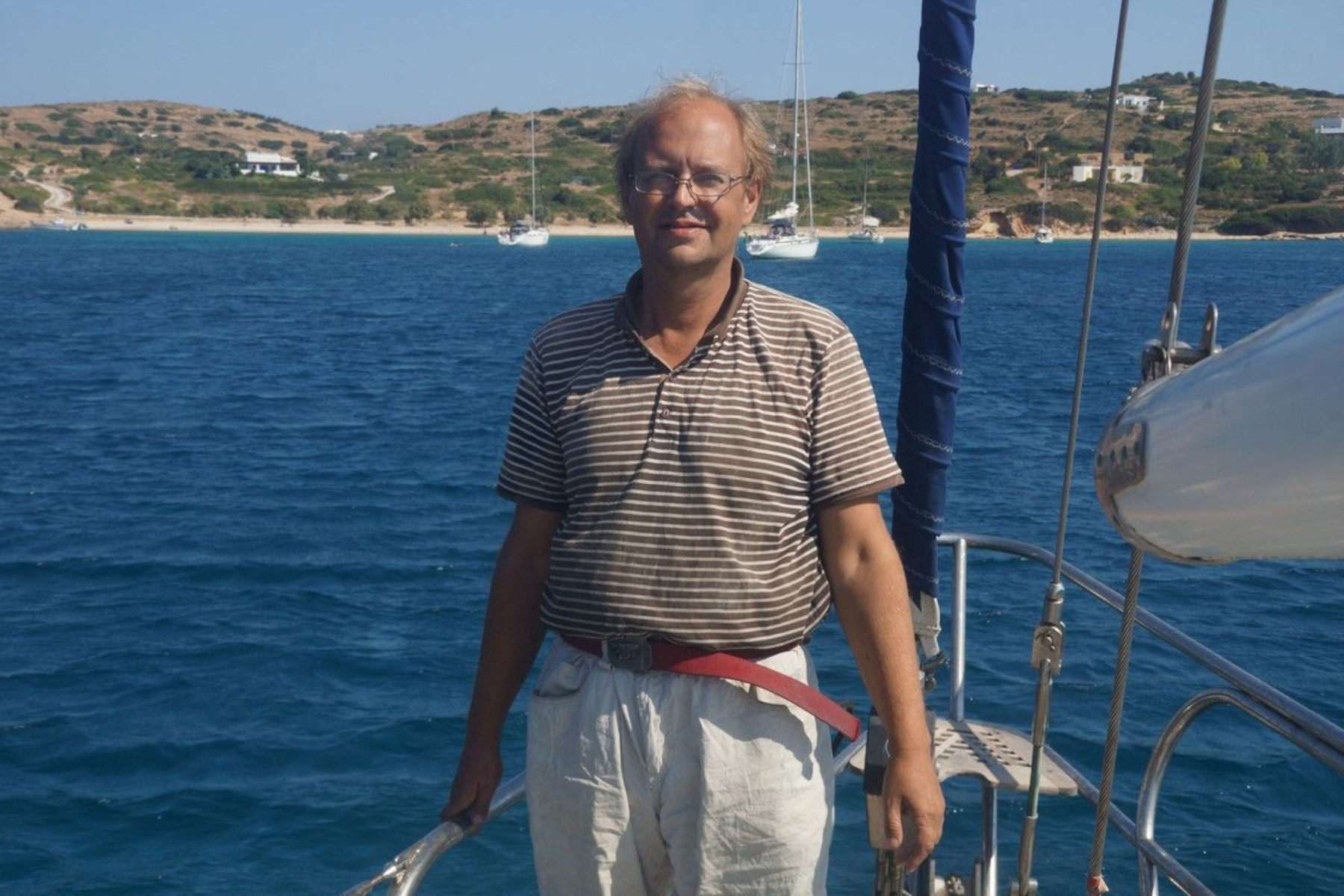
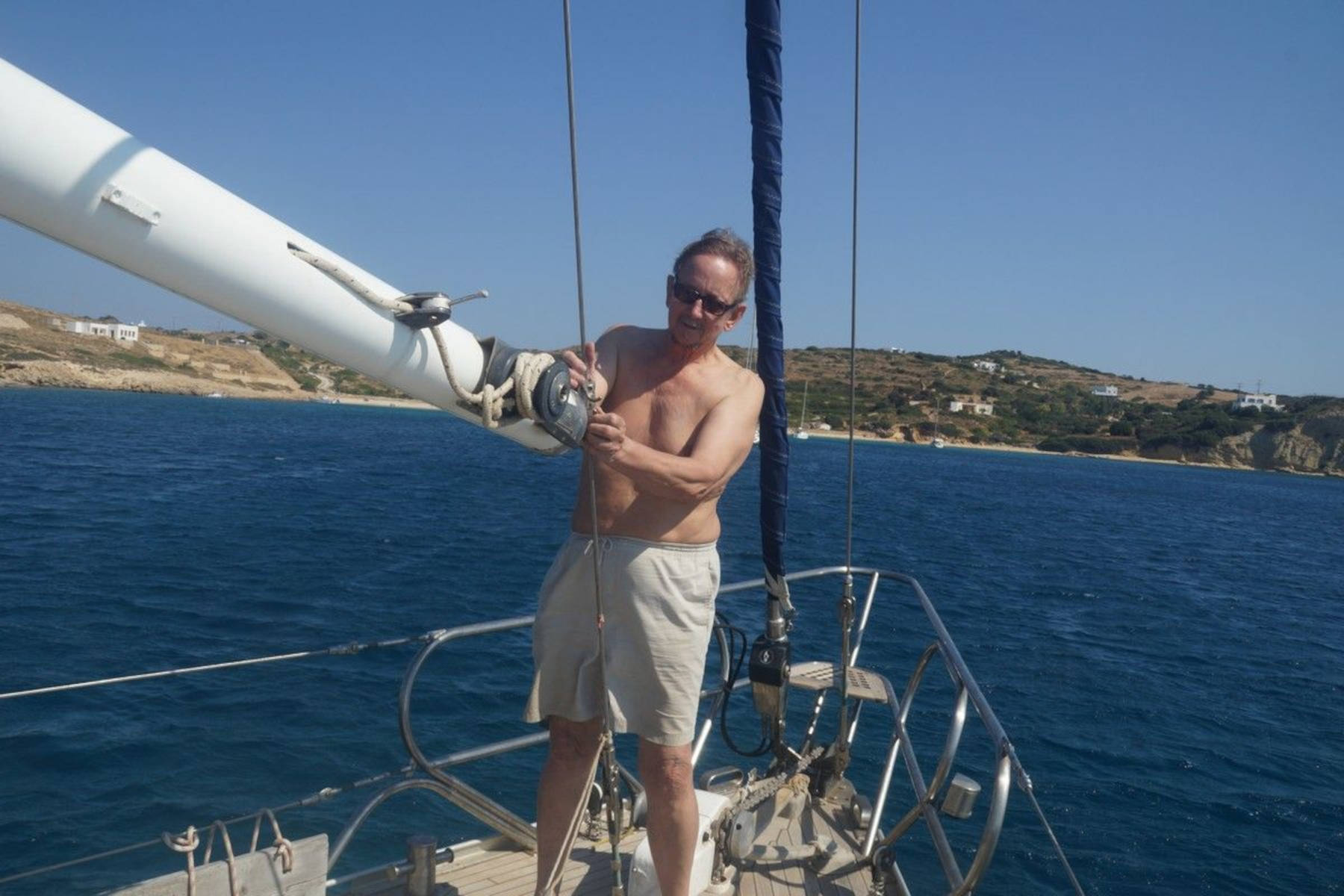
This bay, on the eastern side of the island, is a narrow passage between rocks. The depths are marked as follows: 30 meters in the middle, and about 5 meters closer to the shores. Quite narrow, but other boats are anchored there. And the wind — like through a pipe between two walls — blows straight toward the exit.
We enter. We try. I made three honest attempts. You don’t drop an anchor in 30 meters. And stretching the anchor chain right along the wall is dangerous — if the wind changes, you’ll be thrown onto the rocks, and fenders won’t help.
I even tried stretching the chain across the passage. It worked, but the boat stubbornly turns toward the middle — and that’s where vessels pass.
I asked the neighbors how they manage to stay there. They explained that one line is tied from the stern to the rock. Interesting — how? There’s nothing to attach it to. Do they really hammer anchors into the rock like climbers? No, that’s not for me. I make it a principle never to leave behind not only damage, but even traces of my presence.
So, having gained nothing, we decide to leave again and look for a better place. We could have tried more and surely invented something, but by then it wasn’t just getting dark — the sun had dropped behind the mountains and full night had fallen. Under such conditions, it’s impossible to secure a yacht properly, and risking it didn’t feel right.
We absolutely must return to this bay someday and explore it further by tender. It’s incredibly beautiful, but it’s a place to enter during daylight. Then everything will work out.
So, we leave. And a small problem arises. The left engine won’t start — the battery, having stood unused for so long, never charged. That means it’s dead and needs replacement.
On Ganesh, this can actually be dealt with underway, right at sea, simply by swapping it with another one — for example, using one of the two radio batteries and powering the radio from the service battery instead. On a regular boat, there are usually just two batteries — one for the engine and one for everything else. We have seven on board! There are always options.
The issue is that it’s already dark, it’s night, we want dinner, it’s long past time to sit down and rest. And the nearest spare battery is 200 amp-hours, weighing 40 kilograms! I really don’t want to haul that around.
So we decide to proceed on one engine to the next destination, charging the dead battery from the generator along the way, at least a little. But when a boat has two engines and only one is running, it tends to veer to the side. That means turning off the autopilot and manually compensating with the helm. The speed must be low, otherwise it still pulls sideways.
Said and done. More than two hours at the helm for the skipper. A night passage between islands, essentially by instruments. We reach the same island of Kalymnos, but this time from the southern side. There is a port there.
But by now it’s 10 p.m., completely dark. There’s no hope of help from shore with mooring. It’s known that depths in the port are not sufficient everywhere. And as we see upon entry, there are no free berths.
In such cases, there are two options. The first is to head back out to sea and spend the night underway. The second is to look for a place nearby and drop anchor without entering the port. That’s safer and better.
We choose the second. With great difficulty, we find a spot to anchor near the entrance on the western side, keeping the eastern side as a backup if this doesn’t work. A brutal depth change — from 10 meters straight down to 2! But we didn’t touch, not even once, because we were watching carefully.
As expected, by this time the second battery of the left engine had charged slightly, and the engine started without any problem.
We finally drop anchor. The day is over. Time for dinner. On the menu: excellent beef with mushrooms, vegetables, and so on. And even a little local Greek wine.
But is the day really over? As long as the wind blows strictly from the north, everything is fine and we can sleep peacefully. But will it stay that way all night? And we know that ahead of us there are two meters of depth — a guaranteed and shameful grounding for us.
So the skipper stays on night watch. And not in vain. Toward morning, the wind drops from five knots to one or less. I want to let my partner sleep. I set the sail on the mizzen mast so that even such a weak breeze turns us away from the shoal, like a weather vane. It works. Another hour.
Then the wind dies completely and changes direction. I wake the guest, as agreed, we get ready and leave. Day three begins.

